Teaching bass at a music school has been very rewarding - bass students tend to be highly motivated, and are a diverse bunch, often with very clear ideas about what they would like to learn. Quite often a student will already have tried a few things on his own before finding a teacher, especially in this age of easy access to tabs and tutorials on youtube. I believe the teacher's task is primarily to identify the needs, weaknesses and blind spots of the student, and to provide the necessary tools that will enable the student to overcome the obstacles that limit growth. To be able to do this, the teacher needs to be able to identify every aspect of the student's performance.
When a student has difficulty with timing for instance, one first needs to recognize the root of the problem: does the student have difficulty maintaining the tempo? Or is the problem feeling the pulse, or establishing a groove, or understanding rhythmic notation? Or perhaps the problems might not even be musical in nature - it could be a physical problem, or maybe it's the result of the student feeling nervous in the presence of the teacher? I think identifying the basic problems is step 1 for any teacher. Step 2 would be to find a way to deal with these issues.
On any musical instrument, often different hurdles will present themselves simultaneously: for instance, it's not uncommon for a musical phrase to include a couple of wrong notes, that are also played rhythmically incorrect, while using weird fingering with an attitude that's inappropriate for the song. In such cases I'll try to tackle each issue separately. First we'll figure out the correct notes - if more than two notes are incorrect, I'll save the rest of the lick for later and will correct the first two mistakes first. I will always try to avoid situations where the student needs to process loads of information; I like to create a situation where one doesn't have to think at all and playing becomes automatic.
We'll figure out the best fingering for playing the correct notes. Next we'll repeat these notes a few times in a loop so that the movements of the fingers start to feel comfortable and the sequence is memorised. At the same time we'll try to make sure the phrase is performed rhythmically correct. A metronome or a tapping foot will be used to maintain a steady pulse.
And so on. Usually I will recommend practicing at the correct speed right away, to prevent the student from incorporating unnecessary movements that seem harmless when playing at a low speed but become problematic when speeding up to the required tempo.
Every step of this process not only yields great results in the student, but has been a great inspiration for me as a teacher, forcing me to analyse every aspect of playing, especially the exact movement of each finger, obvious and hidden tensions in the body, and many aspects of timing: pulse, tempo, groove, feel, the division of each beat, understanding and interpreting rhythmic notation. This has made me more aware of all these details in my own playing, improving my own technical abilities and musical understanding along with the student's.
Another thing I love about teaching, is that bass students will often request material that I may not yet be familiar with. Although my own tastes are very eclectic, students have expanded my horizons in a big way, introducing to me many fantastic or interesting bands, musical styles, and bass players. Generally I would say that bass students tend to be pretty serious, dedicated to their instrument and to music, and eager to learn.
My prefered method of teaching is in person, which I do at music school Het Klooster in Woerden (the Netherlands). If you're interested in getting bass lessons from me, please fill out this form. If it's not possible for you to go to Woerden and you'd still like some help with certain bass issues, please send me a message and we can schedule a few lessons online. However I would recommend finding a local teacher.
If you need help with specific songs, I am happy to provide tabs and lead sheets.
LEARNING
In my early days as a teacher, a lot of time would be dedicated to verbal instruction, charts to read, theory to understand, information to memorize. To be frank, this would often be only mildly effective. Sometimes students would have no trouble mastering a difficult song, especially if they really knew and loved it, and would subsequently struggle with simple exercises because they were just too boring or too abstract.
Then when I began working with talented musicians with intellectual disabilities, and verbal instructions and written parts were of no use at all. So over time a different approach materialised. During rehearsals, I would make sure that I knew the song well enough to "fill in the blanks" for every musician's part. Often the lead singer would already know the song, otherwise I would sing the song first. I would play the bass part, initially incorporating many thirds when necessary to indicate if chords are major or minor; incorporating other intrument's licks if they were an essential element of the song, occasionally singing the horn lines. This would be enough for everyone to understand the basic structure and many of the details. During every subsequent rehearsal more details would be picked up by the band, and very quickly even relatively difficult songs would be ready for performance.
I've come to believe that the most effective way to learn music is similar to the way a child learns a language: by listening and imitating. The main goal during any lesson will simply be to be playing as much as possible, student and teacher simultaneously, so that the student will be allowed to experience, absorb and perform all the nuances of timing, phrasing, dynamics, and so on, while having very limited time to think about it.
STUDYING
One of the most thorough and inspiring books I have ever read about studying music is Victor Wooten's The Music Lesson, which basically includes all the advice that I would give any student plus so much more.
A few suggestions that have helped me immensely:
1. Play along with recordings as much as possible, both simple and complex stuff. For bass players especially it's possible to start playing along with simple songs from the very first moment you pick up the bass. This will help the bassist with so much more than just the right notes and rhythm: it will convey a sense of how the line works within the context of the song, it helps maintaining the tempo, it makes studying feel more like making music, and it will demonstrate the different approaches of bass players to sound, timing, improvisation, and all those many aspects that are sometimes hard to define verbally.
2. When facing a problem, or making a mistake, find the correct way to play this and repeat this several times until you are able to play the sequence without mistakes at least three times in a row. Then move on to the next hurdle. It can be tempting to finish playing the entire song as soon as a problematic sequence has been played correctly once. But then the next time around, the same sequence will still feel just as difficult as it did before. It takes repetition for the correct execution to become the obvious and only way of playing the sequence, especially if the ear and the muscles are already accustomed to playing it in a different way. It is my belief that part of the problem with difficult passages is often that it requires too much thinking on the part of the player - what was that note again? what string, what fret, which finger - which often results in unncessary tension in the muscles and many superfluous movements in the fingers. Once such a sequence is repeated often enough for the bassist to know every movement by heart, it will actually become a lot easier to perform because of the elimination of thought processes, panic and anxiety, and superfluous muscular activity.
3. I would encourage any student to learn the basics of classical notation, as well as lead sheets, chord charts and tablature. For practical reasons, but also, classical notation may expand one's understanding of certain details, because it is yet another way of describing what goes on in the music. Any method of notation has advantages as well as disadvantages, so mastering at least the basics of each method of notation is very much recommended.
IMPROVISING
Here's my thoughts on the basics of improvisation. Some musicians seem to be primarily interested in the scales that can be used in a solo, and will subsequently use all the notes from the scale without any rhythmic or melodic purpose. This can result in very boring music, but is also very difficult for the supporting musicians. As a bassist, I feel so much more involved if I have to accompany a solo that has a clear direction or purpose, a melody or a groove, or dynamic development.
So in my workshops I will usually first approach improvisation from a rhythmic foundation. For instance, by singing the improvisations while clapping or dancing a rhythmic pattern. When improvising using different notes, I think the player should know in advance how the notes that will be played are going to sound. An exercise could be to sing a simple phrase which then has to be repeated on the instrument. And the rules that apply to all music also apply to improvisation: it's not just about scales, it's music, so timing, phrasing, tone, every aspect of music is important. This can also be trained using specific exercises.
Once students have mastered the basics of improvisation, I encourage everyone to attempt improvisation within any situation whenever it's possible, with little instruction since the whole point of improvisation is for the musician to be creative, not to be following instructions. However it might be useful to explain basics of music theory, scales, and so on when relevant.
MEMORIES OF MUSICAL FRIENDS AND HEROES
JAAP DEKKER
My first real job as a performing bassist was with Jaap Dekker. When I joined his band I had very little experience, and without any clear instructions or rehearsals was expected to play solid bass lines to a repertoire he had been building in the course of over twenty years. What a fantastic training! It was fun, educational, often bewildering, but I am very thankful for the experience. Sadly, Jaap passed on in 2020. Gone but not forgotten.
CANDYE KANE
Candye Kane was co-founder of United by Music. A great singer and songwriter in the blues shouter tradition, she had a colorful career that included jobs in the adult entertainment industry, which would lead to her becoming something of a role model to a group of very dedicated fans who were inspired by her positive attitude towards sexuality, and to accepting and loving of your own body regardless its size or shape. She had considerable talent as a songwriter, writing songs that address sexual and spiritual matters in a way not often heard these days in the blues genre. By the time I got to work with her, she was battling cancer, and she would include in her concerts long inspirational monologues on the meaning of life and death. I think her continuous fight for people to be accepted regardless of their sexuality or their appearance also led to her championing the cause of people with intellectual disabilities. This eventually resulted in the forming of United by Music. She quickly realised that, to many people, limitations in intellectual abilities would automatically suggest limitations in every other way including music. She proved this assumption to be quite undeserved. Candye was a unique personality; she is much missed and it was a privilege to have known her. I was introduced to her by the wonderful Lisa Otey, who would also introduce me to
PINETOP PERKINS
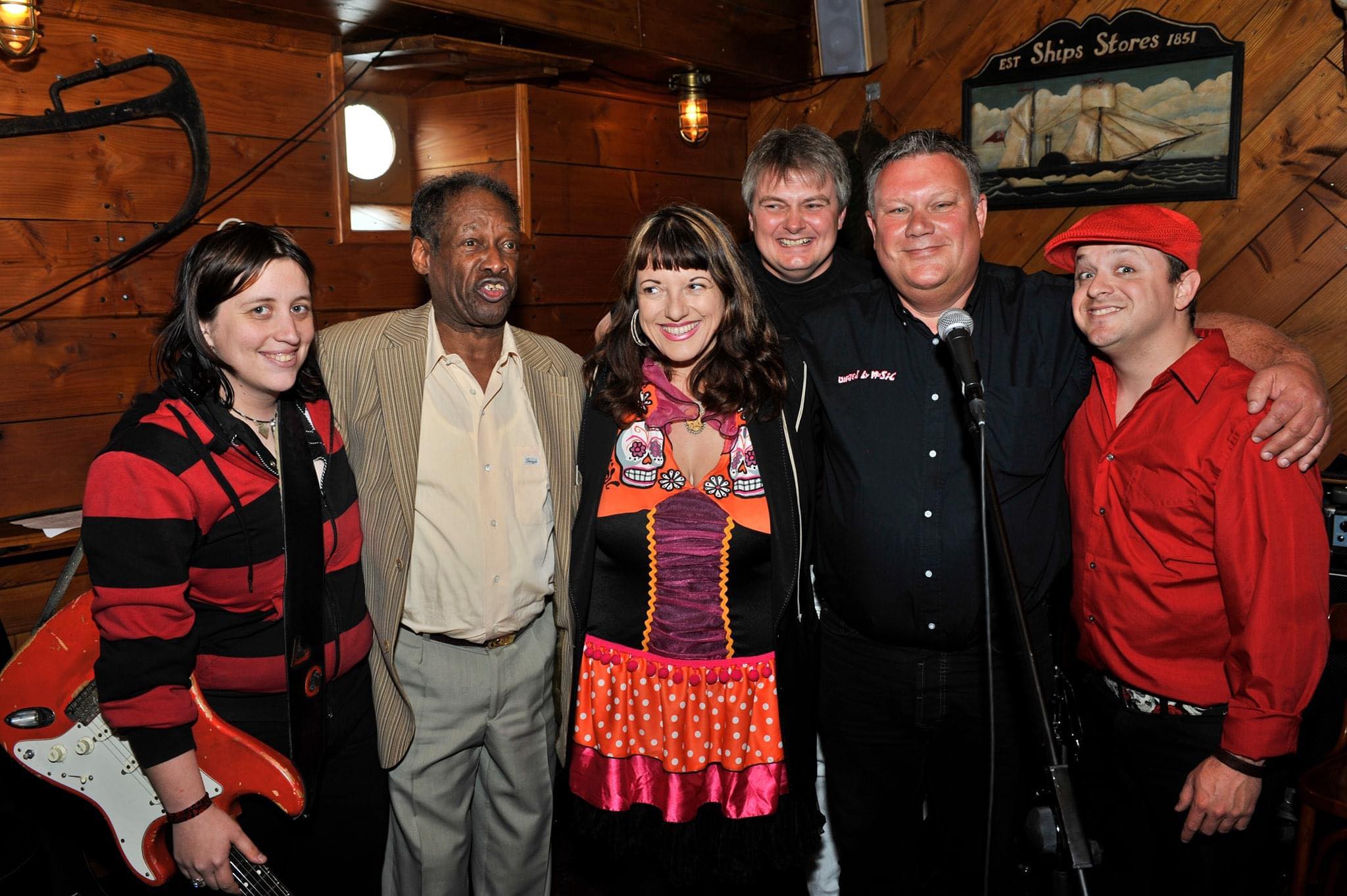
Pinetop Perkins, who I only got to play with one time, when he had just recovered from being hit by a train, at 94 years old. The reason this meeting was so special to me, was the realisation that he had been a witness to just about the whole history of rock music, starting his music career in the 1920s, and that he appeared to be immortal, still playing the piano even after having been hit by a train!
BERRY SELLES
I met Berry when I was just starting to get interested in the origins of the steel guitar, particularly the Western swing era. Berry invited me to join his Western swing band Panhandle Swing, and really helped me get started. His encyclopaedic knowledge of everything even remotely related to cowboy jazz and his boundless enthusiasm continue to inspire me, even if he is no longer with us.
MARCEL SCHIMSCHEIMER AND MEMORIES OF HILVERSUM
Immediately after I finished high school I started my studies at the Hilversum Conservatory. In hindsight I believe I probably should have waited a few years to get some road experience; also I think many teachers at the conservatory itself weren't quite ready to start teaching, but anyway, that's what I did, and it has tought me many a valuable lesson, and also gave me some challenges to overcome. After graduating I lost touch with most of my teachers, although memories have stayed with me and return at unexpected moments. But this week (as I write this it's July 10, 2024) I heard that my favorite teacher Theo de Jong has just retired from his job, and that the teacher closest to me in age Marcel Schimscheimer died last week, shortly after one of my earliest bass heroes Tom Fowler had died, and now I find myself reminiscing about those early school days when a lot of things started happening for me.
I had three important bass teachers. The first, Jan Hollestelle, was the oldest - a legend to me in many ways. I was in awe of his expertise, tone, groove and sage-like presence. Being his student was confrontational. I had always thought I was pretty good as a bass player, and now I realized that I knew next to nothing. He introduced me to some great music that I had never heard before: Donny Hathaway, Steely Dan, Jaco Pastorius. But the moment when I realized that he really was a magician, was one particular occasion when he said that my tone was bad. I was using a rather cheap Ibanez bass with not much happening in the lower frequencies, plugged into a tiny Roland bass cube, while he would show up with some high-end super deluxe bass every lesson, plugged into a huge impressive amp, so I thought his criticism was quite unfair, and I told him so. He laughed at my suggestion that my tone was due to the inferior equipment, he took my bass and without adjusting anything produced a rich full tone, and he gave me his Alembic to try, and all I could get out of it was a tiny soulless note. That was a revelation to me: tone is in the fingers of the player; good gear is only of secondary importance.
My second teacher was Theo de Jong. He was in many ways my favorite teacher. Closer to me in age than Jan but also closer to me in his approach to the bass, with more emphasis on harmony, melody and improvisation and less fixated on groove. I loved his lessons but we both felt that in my case a teacher who focused more on groove might be preferable since that very important aspect of bass playing was sort of under-developed in my playing.
So groove-master Marcel Schimscheimer became my third teacher. What a character! He could turn even the most lame bass part into exciting swinging music. He was so much sought after as a session bassist at the time, that even though in those days he supposedly didn't own a car or a telephone - I seem to recall there was some sort of elaborate ritual involved where you could call his girlfriend's mother and she would then pass on a message - people would put up with this strange protocol because he was such an amazing bassist. (This story may be a myth… there were so many wild stories about our teachers back then…) Having said that, he probably was not really cut out to be a teacher, and many of his lessons were actually rather strange... He would have me play something and then would only say “That was okay”, then I would tell him which parts I thought I played poorly and he would say something like “Yeah, maybe you’re right… » But there's one very important memory that stands out. After I finished my studies, I did some work with a band that I wasn't too comfortable with, I thought we were sub-par and one night we played at some shitty private party where all of a sudden I see Marcel among the guests. I felt embarrassed. I thought: Here's the hottest bass player and he sees me playing with one of the worst bands. (We weren’t that bad but I thought Marcel would probably hate us.) He walked up to me and said it was nice to see me play. I started apologizing for the poor quality of the band, but he shut me up and said: Hey, YOU're playing and I'm only a guest at the party! Implying that playing a gig always trumps anybody who is not playing. It made me rethink many aspects of the musician's life, and I'll be forever grateful for his words.
My life post-conservatory took me in many different directions, but always making music. So to all my teachers I would like to say: thank you very much for sharing your talents, knowledge, life lessons and expertise with us students!
STRANGE GIGS
As a bass player it's often easier to play in many different music styles and idioms than it is for many other instruments. Which is why many bass players manage to get enough work to make a living, but the work might be diverse - as it has been in my case. I have performed in living rooms, at outdoor festivals, in studios, in theaters, small clubs and bars, sometimes unamplified, sometimes using huge PA systems. I have always loved this diversity. It has also often forced me to adapt my playing style to widely different situations. In small venues, without PA systems, my main concern is to balance a good sound in the room with a good sound on stage. I want everybody to hear me and at the same time I don't want to be in anybody's way; it's not my job to upstage anyone. But in larger rooms with PA systems and sound engineers you sometimes wind up having no control over the balance. If my bass is too loud, or not loud enough, I have often found myself forced to adapt the parts I was playing to the circumstances in that room - by avoiding legato passages for instance, or by avoiding the E string.
Of course it all depends on the music, and on the people you have to deal with. I would like to recall some of the funnier situations I would find myself in; most of the time things went quite well but once in a while you have to be prepared to do stuff that wasn't in the original job description. One time in Spain, my bass amp had been provided by the venue. It worked fine for almost the entire concert, but just as we were playing the encore the amp quit, no more bass at all, so I rushed over to the piano to play the final bass notes on the keys. It probably sounded horrible but people told me it was the highlight of the concert - I think people appreciated the spontaneity of the moment!
Another weird thing happened when I was asked to do two concerts with a singer I had never worked with before. Her regular bass player wanted to make sure I would do exactly the same bass parts that he would usually play, so he sent me cds and written parts months in advance and even visited me at my home to check out if everything was as it should be. We did the concert, everything went smoothly and everyone was happy - or so I thought. Apparently one of her managers had complained that hiring substitutes didn't contribute anything to the music if all they did was copy the parts of the original players note for note! So the next concert I did with her, I was instructed to really be a creative presence - she even had me singing a duet with her and had me playing a bass solo which was never normally a part of the show - only to have the other manager complaining the substitutes should know their place and should remain invisible! Later I found out there had been trouble among the two managers, so whatever one party loved, the other would loathe. Still I enjoyed the experience!
In 2004 I decided to take a trip (along with Jan Hoiberg from Norway, who maintains The Band's website) to Woodstock NY to meet a few musical heroes, including Garth and Maud Hudson, Levon Helm and Jim Weider, all from The Band, and their producer and collaborator John Simon. I had never imagined these big name artists and heroes I had admired all my life to be so warm and welcoming and accessible. John and Garth especially were generous with their time, sharing fantastic stories about many of the musical milestones that had such an important influence on my musical development. Shortly after arriving in Woodstock, Garth showed up late at night at the hotel, jumping down the hallway to deliver a couple of bags filled with candy - it was Easter weekend! Later on we spent many hours at a restaurant, Garth relating so many fantastic stories and plans. His wife Maud was wonderful too. Before our dinner, Garth and Maud took us on a car trip in the neighborhood, pointing out the residencies of all the incredible musicians living in the area. A memory I will cherish forever.
We also attended one of Levon Helm's Midnight Rambles, an incredible evening of music. Levon was recuperating from surgery and could barely sing but he was drumming and playing mandolin and singing as much as his health would allow. Other artists that evening included Ollabelle, Larry Campbell, Jimmy Vivino and many others.
John Simon also invited us into his home, sharing memories of many fantastic recording sessions with The Band and other artists, even performing a few new and old songs for us in his living room, offering some very tasty homemade soup, and then asking us to assist him moving a couple of rocks in his garden. Another wonderful human being. John as a producer had been involved with some of the albums that had been of tremendous influence to me: The Band's first two albums and their Last Waltz farewell concert; but also albums by Blood Sweat & Tears, Janis Joplin, Gordon Lightfoot, Hirth Martinez, and David Sanborn. He also recorded beautiful albums under his own name and wrote fantastics songs - Gil Evans recorded one of these. It was very special to be in the presence of the man who had been there when many of the sounds that shaped my world and dreams were first conceived.
 In 2004 I decided to take a trip (along with Jan Hoiberg from Norway, who maintains The Band's website) to Woodstock NY to meet a few musical heroes, including Garth and Maud Hudson, Levon Helm and Jim Weider, all from The Band, and their producer and collaborator John Simon. I had never imagined these big name artists and heroes I had admired all my life to be so warm and welcoming and accessible. John and Garth especially were generous with their time, sharing fantastic stories about many of the musical milestones that had such an important influence on my musical development. Shortly after arriving in Woodstock, Garth showed up late at night at the hotel, jumping down the hallway to deliver a couple of bags filled with candy - it was Easter weekend! Later on we spent many hours at a restaurant, Garth relating so many fantastic stories and plans. His wife Maud was wonderful too. Before our dinner, Garth and Maud took us on a car trip in the neighborhood, pointing out the residencies of all the incredible musicians living in the area. A memory I will cherish forever.
 John Simon also invited us into his home, sharing memories of many fantastic recording sessions with The Band and other artists, even performing a few new and old songs for us in his living room, offering some very tasty homemade soup, and then asking us to assist him moving a couple of rocks in his garden. Another wonderful human being. John as a producer had been involved with some of the albums that had been of tremendous influence to me: The Band's first two albums and their Last Waltz farewell concert; but also albums by Blood Sweat & Tears, Janis Joplin, Gordon Lightfoot, Hirth Martinez, and David Sanborn. He also recorded beautiful albums under his own name and wrote fantastics songs - Gil Evans recorded one of these. It was very special to be in the presence of the man who had been there when many of the sounds that shaped my world and dreams were first conceived.